

D. W. Cahill, To the People of Ireland, The Auburn (NY) Union, 5 Nov 1860
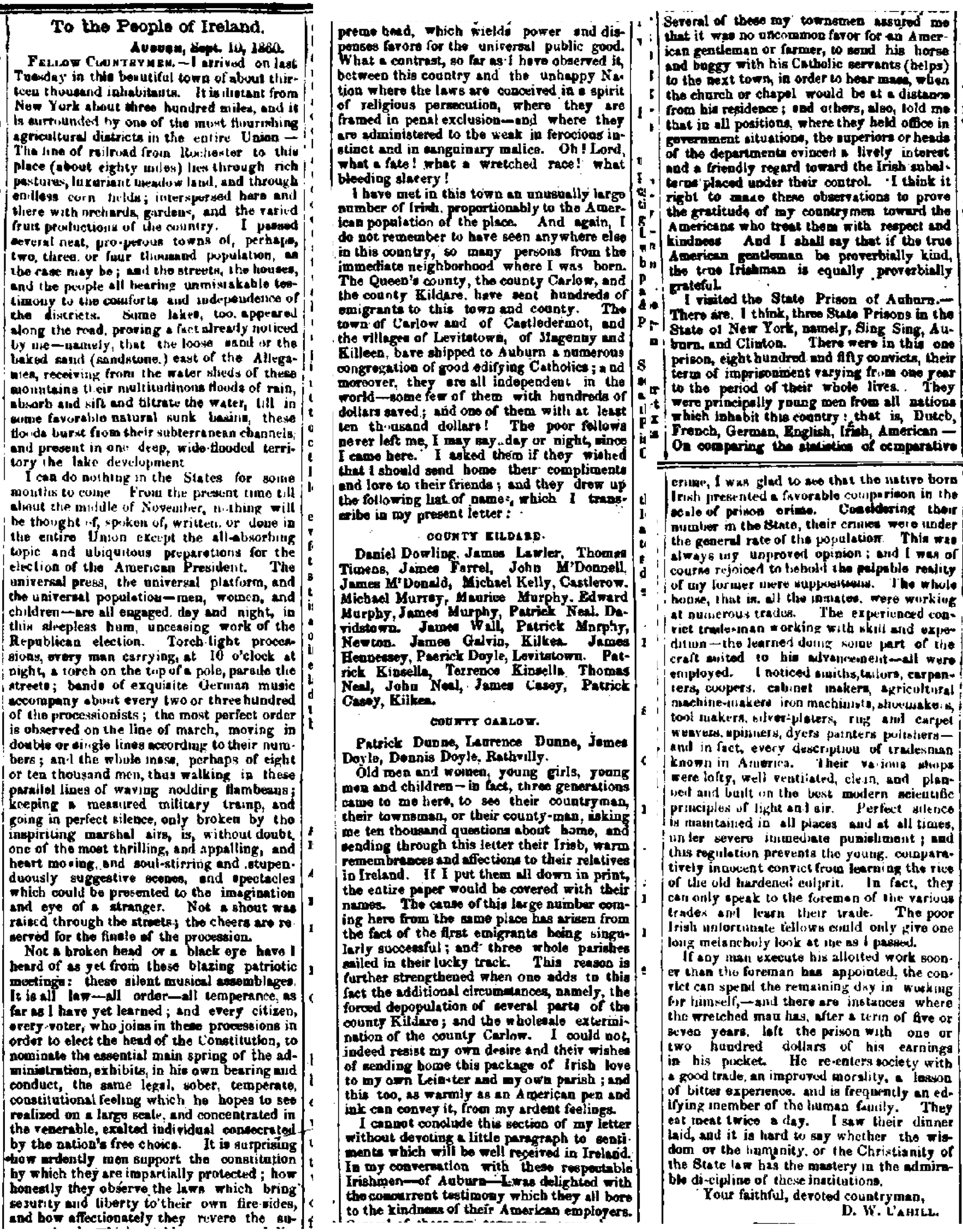
To the People of Ireland.
AUBURN, Sept. 10, 1860. FELLOW COUNTRYMEN.—I arrived on last Tuesday in this beautiful town of about thirteen thousand inhabitants. It is distant from New York about three hundred mile*, and it is surrounded by one of the most flourishing agricultural districts in the entire Union — The line of railroad from Rochester to this place (about eighty miles) lies through rich pastures,, luxuriant meadow land, and through endless corn fields; interspersed here and there with orchards, gardens, and the varied fruit productions of the country. I passed several neat, prosperous towns of, perhaps, two, three, or four thousand population, as the case may be; and the streets, the houses, and the people all hearing unmistakable testimony to the comfort and independence of the districts. Some lakes, too, appeared along the road, proving a fact already noticed by me—namely, that the loose sand or the baked sand (sandstone) east of the Alleghenies, receiving from the water sheds of these mountains their multitudinous floods of rain, absorb and sift and nitrate the water, till in some favorable natural sunk basins, these floods burst from their subterranean channels, and present in one deep, wide-flooded territory the lake development
I can do nothing in the States for some months to come From the present time till about the middle of November, nothing will be thought of, spoken of, written, or done in the entire Union except the all-absorbing topic and ubiquitous preparations for the election of the American President. The universal press, the universal platform, and the universal population—men, women, and children—are all engaged, day and night, in this sleepless hum, unceasing work of the Republican election. Torchlight processions, every man carrying, at 10 o’clock at night, a torch on the top of a pole, parade the streets; bands of exquisite German music accompany about every two or three hundred of the processionists ; the most perfect order is observed on the line of march, moving in double or single lines according to their numbers ; and the whole mass, perhaps of eight or ten thousand men, thus walking in these parallel lines of waving nodding flambeaus; keeping a measured military tramp, and going in perfect silence, only broken by the inspiriting marshal airs, is, without doubt, one of the most thrilling, and appalling, and heart moving, and soul-stirring and stupendously suggestive scenes, and spectacles which could be presented to the imagination and eye of a stranger. Not a shout was raised through the streets the cheers are re served for the finale of the procession.
Not a broken head or a black eye have I heard of as yet from these blazing patriotic meetings: these silent musical assemblages. It is all law—all order—all temperance, as far as I have yet learned ; and every citizen, every voter, who joins in these processions in order to elect the head of the Constitution, to nominate the essential main spring of the administration, exhibits, in hit own bearing and conduct, the same legal, sober, temperate, constitutional feeling which he hopes to see realized on a large scale, and concentrated in the venerable, exalted individual consecrated by the nation’s free choice. It is surprising how ardently men support the constitution by which they are impartially protected ; how honestly they observe the laws which bring security and liberty to their own fire-sides, and how affectionately they revere the supreme head, which wields power and dispenses favors for the universal public good. What a contrast, so far as I have observed it, between this country and the unhappy Nation where the laws are conceived in a spirit of religious persecution, where they are framed in penal exclusion—and where they are administered to the weak in ferocious instinct and in sanguinary malice. Oh! Lord, what a fate! what a wretched race! what bleeding slavery!
I have met in this town an unusually large number of Irish, proportionably to the American population of the place. And again, I do not remember to have seen anywhere else in this country, so many persons from the immediate neighborhood where I was born. The Queen’s county, the county Carlow, and the county Kildare, have sent hundreds of emigrants to this town and county. The town of Carlow and of Castledermot, and the villages of Levitstown, of Magenny and Killeen, have shipped to Auburn a numerous congregation of good edifying Catholics; and moreover, they are all independent in the world—some few of them with hundreds of dollars saved; and one of them with at least ten thousand dollars! The poor fellows never left me, I may say…day or night, since I came here. I asked them if they wished that i should send home their compliments and love to their friends ; and they drew up the following list names, which I transcribe in my present letter:
COUNTY KILDARE
Daniel Dowling, James Lawler, Thomas Timens, James Farrel, John McDonnell, James McDonald, Michael Kelly, Castlerow.
Michael Murrey, Maurice Murphy, Edward Murphy, James Murphy, Patrick Neal, Davidstown.
James Wall, Patrick Murphy, Newton.
James Galvin, Kilkea.
James Hennessey, Patrick Doyle, Levitstown.
Patrick Kinsella, Terrence Kinsella, Thomas Neal, James Casey, Patrick Casey, Kilkea.
COUNTY CARLOW
Patrick Dunne, Laurence Dunne, James Doyle, Dennis Doyle, Rathvilly.
Old men and women, young girls, young men and children—in fact, three generations came to me here, to see their countryman, their townsman, or their county-man, asking me ten thousand questions about home, and sending through this letter their Irish, warm remembrances and affections to their relatives in Ireland. If I put them all down in print, the entire paper would be covered with their names. The cause of this large number coming here from the same place has arisen from the fact of the first emigrants being singularly successful; and three whole parishes sailed in their lucky track. This reason is further strengthened when one adds to this fact the additional circumstances, namely, the forced depopulation of several parts of the county Kildare; and the wholesale extermination of the county Carlow. I could not, indeed resist my own desire and their wishes of sending home this package of Irish love to my own Leinster and my own parish ; and this too, as warmly as an American pen and ink can convey it, from my ardent feelings.
I cannot conclude this section of my letter without devoting a little paragraph to sentiments which will be well received in Ireland. In my conversation with these respectable Irishmen—of Auburn—I was delighted with the concurrent testimony which they all bore to the kindness of their American employers. Several of these my townsmen assured me that it was no uncommon favor for an American gentleman or farmer, to send his horse and buggy with his Catholic servants (helps) to the next town, in order to hear mass, when the church or chapel would be at a distance from his residence; and others, also, told me that in all positions, where they held office in government situations, the superiors or heads of the departments evinced a lively interest and a friendly regard toward the Irish subalterns placed under their control. I think it right to make these observations to prove the gratitude of my countrymen toward the Americans who treat them with respect and kindness. And I shall say that if the true American gentleman be proverbially kind, the true Irishman is equally proverbially grateful.
I visited the State Prison of Auburn.—There are, I think, three State Prisons in the State of New York, namely Sing Sing, Auburn, and Clinton. There were in this one prison, eight hundred and fifty convicts, their term of imprisonment varying front one year to the period of their whole lives. They were principally young men from all nations which inhabit this country; that is, Dutch, French, German, English, Irish, American —On the comparing the situation of comparative crime, I was glad to see that the native born Irish presented a favorable comparison in the scale of prison crime. Considering their number in the State, their crimes were under the general rate of the population. This was always my unproved opinion; and I was of course rejoiced to behold the palpable reality of my former mere suppositious. The whole house, that is, all the inmates, were working at numerous trades. The experienced convict tradesman working with skill and expedition—the learned doing some part of the craft suited to his advancement—all were employed. I noticed smiths, tailors, carpenters, coopers, cabinet makers, agricultural machine-makers iron machinists, shoemakers, tool makers, silver-platers, rug and carpet weavers, spinners, dyers painters polishers — and in fact, every description of tradesman known in America. Their various shops were lofty, well ventilated, clean, and planned and built on the best modern scientific principles of light and air. Perfect silence is maintained in all places and at all times, under severe immediate punishment; and this regulation prevents the young, comparatively innocent convict from learning the vice of the old hardened culprit. In fact, they can only speak to the foremen of the various trades and learn their trade. The poor Irish unfortunate fellows could only give one long melancholy look at me as I passed.
If any man execute his allotted work sooner than the foreman has appointed, the convict can spend the remaining day in working for himself,—and there are instances where the wretched man has, after a term of five or seven years, left the prison with one or two hundred dollars of his earnings in his pocket. He re-enters society with a good trade, an improved morality, a lesson of bitter experience, and is frequently an edifying member of the human family. They eat meat twice a day. I saw their dinner laid, and it is hard to say whether the wisdom or the humanity, or the Christianity of the State law has the mastery in the admirable discipline of these institutions.
Your faithful, devoted countryman,
D. W. CAHILL.